John Brooks offers industrial automation engineering support to engineering, agricultural and forestry industries, food manufacturers, dairy farmers, craft breweries, boutique winemakers, and other manufacturers with parts supply, expert advice and personal service across New Zealand since 1964.
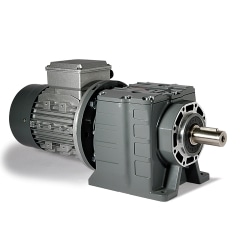
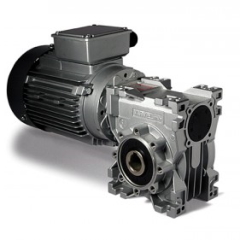
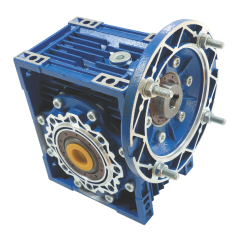
As a result, torque output will be directly proportionate to the speed output of the gearbox. Both Gearboxes have internal gearing acting as the driving mechanism, namely worm and wheel for worm gearboxes and two set of gears, bevel and helical gears for Helical bevel gearboxes. Both are available in aluminum, cast iron and stainless-steel housing configurations. Both have hollow shaft outputs as well as female IEC inputs.
Here at John Brooks, we offer unique solutions that are interchangeable with all leading brands and stocked locally in New Zealand. So, what are the differences between the two? Worm gearboxes are typically low torque applications whilst helical bevel units are used for higher load and torque applications. Worm gearboxes have set ratio’s ranging from 280RPM to 14 RPM @ 1400 RPM Input speed , whilst helical bevel units have significantly more options with speeds between 1.5 RPM – 900 RPM. Worm gearbox efficiencies are the least efficient as the sliding action of the worm and wheel creates heat thus reducing the torque output, whilst Helical bevel gearboxes rotating action and can achieve efficiencies between 94%-98% Due to higher efficiency of the helical bevel, the input kilowatts required are reduced when compared to the worm gearbox and achieve the same output torque.
Worm gearboxes are most commonly used in packaging equipment, small machinery, and conveyors whilst helical bevel gearboxes can be used in food industries, winches, hoists and conveyors to name a few. John Brooks has a wide range of expertise spread across 3 branches to help assist in selecting, assembling, and delivering solutions you can trust. If you’re not sure which gearbox to select, contact your local branch, and a John Brooks representative will be in contact to discuss your needs and requirements.
Can be incorporated with any of our Metric IEC frame AC or DC motors to make a cost-effective gearmotor which is one of the most price effective in the market
 My Account
 Call now:
Auckland
•
Wellington
•
Christchurch
Call now:
Auckland
•
Wellington
•
Christchurch